B2 Adult Interactive Reading Lesson

The Blue-Ringed Octopus

A tiny sea creature with beauty, intelligence, and danger

In this lesson, you will explore one of the ocean’s most fascinating animals: the blue-ringed octopus. You will learn key vocabulary, read an engaging article, discuss ideas, practise controlled grammar, work on prepositions, and complete written homework in the same premium adult lesson format as the approved Glowcation lesson.
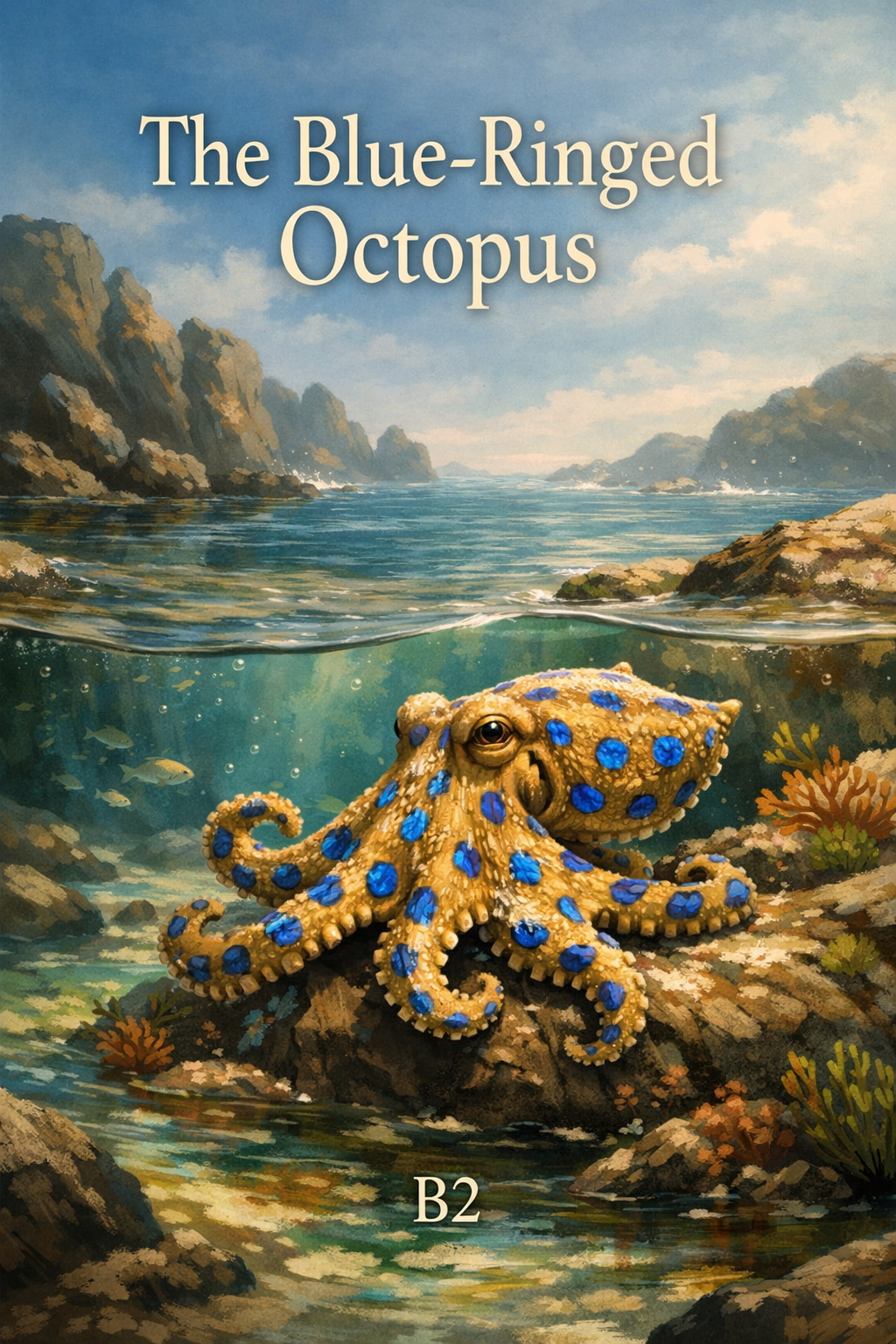
The Blue-Ringed Octopus cover image

Vocabulary

Click each card to flip it. Use Speak for pronunciation and Translate for a quick support hint.

venom
noun
Translation help appears here.
Tap to flip →
Definition: a poisonous substance produced by certain animals and used to hunt or defend themselves.
Example: The octopus uses venom to subdue its prey.
Synonym: toxin
Simple alternative: animal poison
toxin
noun
Translation help appears here.
Tap to flip →
Definition: a poisonous substance that can damage living things.
Example: The toxin in the venom can affect the nervous system very quickly.
Synonym: poison
Simple alternative: harmful poison
sheltered
adjective
Translation help appears here.
Tap to flip →
Definition: protected from wind, waves, danger, or unwanted attention.
Example: The octopus often lives in sheltered coastal spaces near rocks.
Synonym: protected
Simple alternative: safe and covered
survival
noun
Translation help appears here.
Tap to flip →
Definition: the process or fact of continuing to live, especially in difficult conditions.
Example: Camouflage plays an important role in the animal’s survival.
Synonym: endurance
Simple alternative: staying alive
remarkable
adjective
Translation help appears here.
Tap to flip →
Definition: unusual, impressive, or surprising in a way that deserves attention.
Example: It is a remarkable creature because it is both tiny and extremely powerful.
Synonym: extraordinary
Simple alternative: very unusual
species
noun
Translation help appears here.
Tap to flip →
Definition: a group of animals or plants that are of the same basic type.
Example: This species is found in coastal waters in parts of the Pacific region.
Synonym: type
Simple alternative: kind of animal
defence
noun
Translation help appears here.
Tap to flip →
Definition: something used to protect against attack, harm, or danger.
Example: Its bright rings are part of its defence system.
Synonym: protection
Simple alternative: way to protect itself
secretive
adjective
Translation help appears here.
Tap to flip →
Definition: likely to hide, avoid attention, or keep things out of view.
Example: The octopus is a secretive animal that is easy to miss.
Synonym: hidden
Simple alternative: not easy to see
shelter
noun / verb
Translation help appears here.
Tap to flip →
Definition: a safe place that gives protection, or the act of protecting something.
Example: Small crevices can provide shelter from predators and rough water.
Synonym: refuge
Simple alternative: safe place
disturbed
adjective
Translation help appears here.
Tap to flip →
Definition: upset, alarmed, or affected because something has broken a peaceful situation.
Example: The blue rings appear brighter when the animal feels disturbed.
Synonym: alarmed
Simple alternative: upset / bothered
habitat
noun
Translation help appears here.
Tap to flip →
Definition: the natural environment in which an animal or plant normally lives.
Example: Rock pools and reefs can form part of the octopus’s habitat.
Synonym: environment
Simple alternative: natural home
camouflage
noun / verb
Translation help appears here.
Tap to flip →
Definition: a colour, pattern, or behaviour that helps something blend in and remain hidden.
Example: Its camouflage makes it difficult to notice in shallow water.
Synonym: concealment
Simple alternative: hiding colour
predator
noun
Translation help appears here.
Tap to flip →
Definition: an animal that hunts, catches, and eats other animals.
Example: Even a small predator can be highly dangerous.
Synonym: hunter
Simple alternative: hunting animal
cautious
adjective
Translation help appears here.
Tap to flip →
Definition: careful to avoid danger, mistakes, or trouble.
Example: Swimmers should be cautious near rocky coastal areas.
Synonym: careful
Simple alternative: very careful
paralyse
verb
Translation help appears here.
Tap to flip →
Definition: to make a person, animal, or body part unable to move.
Example: The venom can paralyse small prey very quickly.
Synonym: immobilise
Simple alternative: stop from moving
encounter
noun / verb
Translation help appears here.
Tap to flip →
Definition: to meet someone or something, often by chance.
Example: Most people only encounter this animal accidentally.
Synonym: come across
Simple alternative: meet by chance
crevice
noun
Translation help appears here.
Tap to flip →
Definition: a small narrow opening or crack, especially in rock.
Example: The octopus may hide inside a crevice during the day.
Synonym: crack
Simple alternative: narrow space
shallow
adjective
Translation help appears here.
Tap to flip →
Definition: not deep; having little distance from top to bottom.
Example: The species often lives in shallow coastal waters.
Synonym: not deep
Simple alternative: low-depth
reputation
noun
Translation help appears here.
Tap to flip →
Definition: the opinion that people generally have about someone or something.
Example: The animal has a dangerous reputation around the world.
Synonym: image
Simple alternative: what people think
aggressive
adjective
Translation help appears here.
Tap to flip →
Definition: behaving in an attacking, forceful, or hostile way.
Example: Experts say the octopus is not naturally aggressive.
Synonym: hostile
Simple alternative: ready to attack

Reading

Read the article and use the browser audio controls if you want to listen to the text.

The blue-ringed octopus is one of the smallest and most famous sea creatures in the world. At first glance, it may not seem especially dramatic. Its body is small, and when it is relaxed, it often looks pale brown or yellow. However, when the animal feels disturbedupset or alarmed, bright blue rings or lines can suddenly appear across its skin. These markings are not simply decorative. They act as a warning signal to other animals and to humans.

Blue-ringed octopuses usually live in shallownot deep coastal waters, especially around reefs, rock pools, and sheltered areas near the shore. Their habitatnatural home may include shells, coral, old bottles, and small rocky crevicesnarrow cracks where they can hide. Because they have soft bodies, these protected spaces are important for survival. They also use camouflageblending into surroundings very effectively, which helps them stay hidden from danger and move close to prey without being noticed.

Although the animal has a frightening reputationgeneral opinion people have, it is not naturally aggressiveready to attack. In fact, it is generally shy and prefers to avoid trouble. Most people only encountermeet by chance one accidentally. The real danger comes when someone tries to touch, pick up, or corner it. Like many sea hunters, it is a predatoranimal that hunts other animals, and it uses powerful venompoison from an animal to hunt small crabs, fish, and other prey.

This venom contains a toxin that can paralysestop movement prey very quickly. That same defence can also be extremely dangerous to humans. For that reason, visitors exploring rock pools and reefs should be cautiouscareful and aware of danger in places where this species lives. The safest rule is simple: admire the animal from a distance and leave it alone. Its bright rings may appear beautiful, but they are part of a highly effective warning system.

The blue-ringed octopus reminds us that size does not always match power. It is tiny, secretive, and easy to miss, yet it has become one of the best-known sea animals in the world. Scientists, divers, and nature lovers continue to study it because it combines intelligence, mystery, beauty, and danger in one remarkable creature. For language learners, it is also an excellent topic because it shows how nature can be both fascinating and serious at the same time.

Discussion

Answer in full sentences and explain your ideas clearly.

1. Why do you think humans are often attracted to beautiful but dangerous animals?

2. Do warning colours in nature seem effective to you? Why or why not?

3. Should tourists receive more information about dangerous sea life before visiting coastal areas?

4. Why do some people still take risks even when warning signs are clear?

5. Would you enjoy exploring rock pools, or would you feel too nervous? Explain.

6. Which is more important in nature: curiosity or caution?

Vocabulary Check

Choose the best answer.

1. What does habitat mean?

2. If an animal is aggressive, it is likely to be:

3. A crevice is:

4. To paralyse something means to:

5. Cautious people usually behave in a:

6. Camouflage helps an animal to:

7. A dangerous reputation means:

8. If something is sheltered, it is:

9. The word survival is closest in meaning to:

10. If something is remarkable, it is:

11. A species is:

12. In this lesson, defence means:

13. If an animal is secretive, it is usually:

14. A toxin is:

15. Which sentence best uses shelter?

Grammar / Controlled Practice

Complete the tasks, then check the model answers directly underneath your own sentence.

1. Change to the present perfect:
Scientists study blue-ringed octopuses carefully.

Scientists have studied blue-ringed octopuses carefully.

2. Change to the past simple:
The octopus hides in a rocky crevice.

The octopus hid in a rocky crevice.

3. Change to the future with “will”:
Visitors remain cautious near rock pools.

Visitors will remain cautious near rock pools.

4. Change to the past continuous:
The diver watches the animal from a distance.

The diver was watching the animal from a distance.

5. Rewrite using “because”:
The octopus stayed hidden. It felt disturbed.

The octopus stayed hidden because it felt disturbed.

6. Rewrite in the passive voice:
The venom paralyses small prey.

Small prey is paralysed by the venom.

Prepositions

Choose the best preposition.

1. The octopus often hides ___ narrow cracks in rocks.

2. It is usually found ___ shallow coastal waters.

3. People should not reach ___ unknown shells or holes.

4. The blue rings become brighter when the animal is ___ stress.

5. The animal may move quickly ___ cover if it feels threatened.

6. Visitors should admire it ___ a safe distance.

Homework

Complete all three homework sections. Use Show Answers to compare your work, then Reset if you want to try again.

Finish the Sentence

1. The blue-ringed octopus...

Model answer: The blue-ringed octopus lives in shallow coastal waters and uses warning colours for protection.

2. When it feels...

Model answer: When it feels disturbed, its bright blue rings become more visible.

3. People should never...

Model answer: People should never try to pick it up or touch it with bare hands.

4. One reason it...

Model answer: One reason it survives well is that it can hide in tiny rocky crevices.

5. Its venom can...

Model answer: Its venom can paralyse prey very quickly and make it helpless.

6. The safest rule...

Model answer: The safest rule is to admire the animal from a distance and leave it alone.

7. Scientists continue to...

Model answer: Scientists continue to study this species because it is fascinating and dangerous.

8. Although it is...

Model answer: Although it is small, it has a very powerful defence system.

Choose the Vocabulary Word

1. This word means the natural place where an animal lives.

2. This word means a poisonous substance produced by an animal.

3. This word means careful because danger may be present.

4. This word means a narrow crack in a rock or wall.

5. This word means to stop movement in part or all of the body.

6. This word describes an animal that hunts other animals.

7. This word means to meet something by chance.

8. This word means colours or patterns that help something stay hidden.

Rewrite in the Correct Tense

1. Change to the present perfect:
The diver sees the octopus near the reef.

The diver has seen the octopus near the reef.

2. Change to the past simple:
The animal hides in a rocky crevice.

The animal hid in a rocky crevice.

3. Change to the future with “will”:
Scientists continue to study its venom.

Scientists will continue to study its venom.

4. Change to the past continuous:
The visitors watch the rock pool carefully.

The visitors were watching the rock pool carefully.

5. Change to the present perfect continuous:
Researchers study warning colours for years.

Researchers have been studying warning colours for years.

6. Change to the past perfect:
The octopus escapes before the diver arrives.

The octopus had escaped before the diver arrived.

7. Change to the future continuous:
The team observes the species tomorrow afternoon.

The team will be observing the species tomorrow afternoon.

8. Change to the passive voice:
The venom paralyses small prey quickly.

Small prey is paralysed quickly by the venom.